
Stop Designing Offices for Millennials: The $1M Mistake You’re Making Right Now

I’m going to be direct, because as a founder, I know you don't have time for fluff. If your current office redesign plan is centered around aesthetics, Instagrammable "breakout zones," or, God forbid, bringing back the ping-pong table to lure people "back to work," you are burning cash.
You aren’t designing a coffee shop. You are designing a high-performance engine for human capital.
For a long time, the commercial design conversation has been dominated by surface-level aesthetics. We’ve been told that cool colors and beanbags equals "culture." But as the founder of Maybeck Design, I have spent years analyzing how spatial geometry impacts cognitive load and bottom-line productivity. I am here to tell you: The era of aesthetic-first design is over.
If you want to survive the 2026 economic landscape, you must shift your focus from how the space looks to how the space thinks. At Maybeck Design, we help CBOs stop asking if their employees "like" the office and start asking if the office makes them effective.
We call this Psycho-Strategic Design. It is the precise intersection where human psychology meets strategic business goals, optimized by AI-driven spatial data.
The Cognitive Crisis in the Modern Office
Your employees—your single largest line item—are facing a cognitive crisis. The constant low-level stress of navigating loud, open-plan environments, the fatigue of poorly designed task lighting, and the subtle "othering" felt in spaces that aren’t sensory-inclusive are real performance inhibitors.
If you are a CBO looking for a new commercial space, you aren't just buying square footage. You are acquiring the physical framework that will either accelerate your team's focus or sabotage it.
I have sat in countless boardrooms where the debate is about the color palette. Let me reframe that: The debate should be about whether a specific palette lowers cortisol levels by 15% to increase sustained attention during 3 PM meetings.
That is the level of depth your office design needs today.
The Psychology of High-Performance Spatial Geometry
Psycho-Strategic Design doesn’t guess; it uses data and proven neurological principles. Your space should subtly direct behavior. Every architectural line, every acoustic panel, and every light fixture is a psychological prompt.
1. The Anatomy of Focused Flow
Our brains are hardwired to scan the environment for threats. In an unstructured open office, our brains are in constant, exhausting hyper-vigilance. The result? Rapid cognitive fatigue.
We counter this by designing "Nesting Zones"—enclosed or semi-enclosed, acoustically private spaces designed specifically for flow state. These are not just phone booths. They are scientifically optimized micro-environments (think tuned sensory inputs and bio-adaptive lighting) that signal to the brain: "You are safe. You may focus."
The Strategic ROI: A 20% reduction in acoustic distractions can recover up to 86 minutes of productive time per employee, per day.
2. Radical Trust: Sensory-Inclusive Design
True performance comes from psychological safety. If your team feels hyper-visible or constantly judged, they will mask their true behaviors, stifling innovation. We prioritize sensory-inclusive environments that honor neurodiversity.
This means moving beyond standard accessibility. It means creating a choice of environments: low-stimulation, high-focus cocoons vs. high-energy collaborative hubs. When we give people agency over their physical environment, they reward us with higher engagement and reduced burnout.
Founder’s Insight: I find that CBOs often mistake "collaboration" for "visibility." They are not the same. Forced visibility breeds performance anxiety.
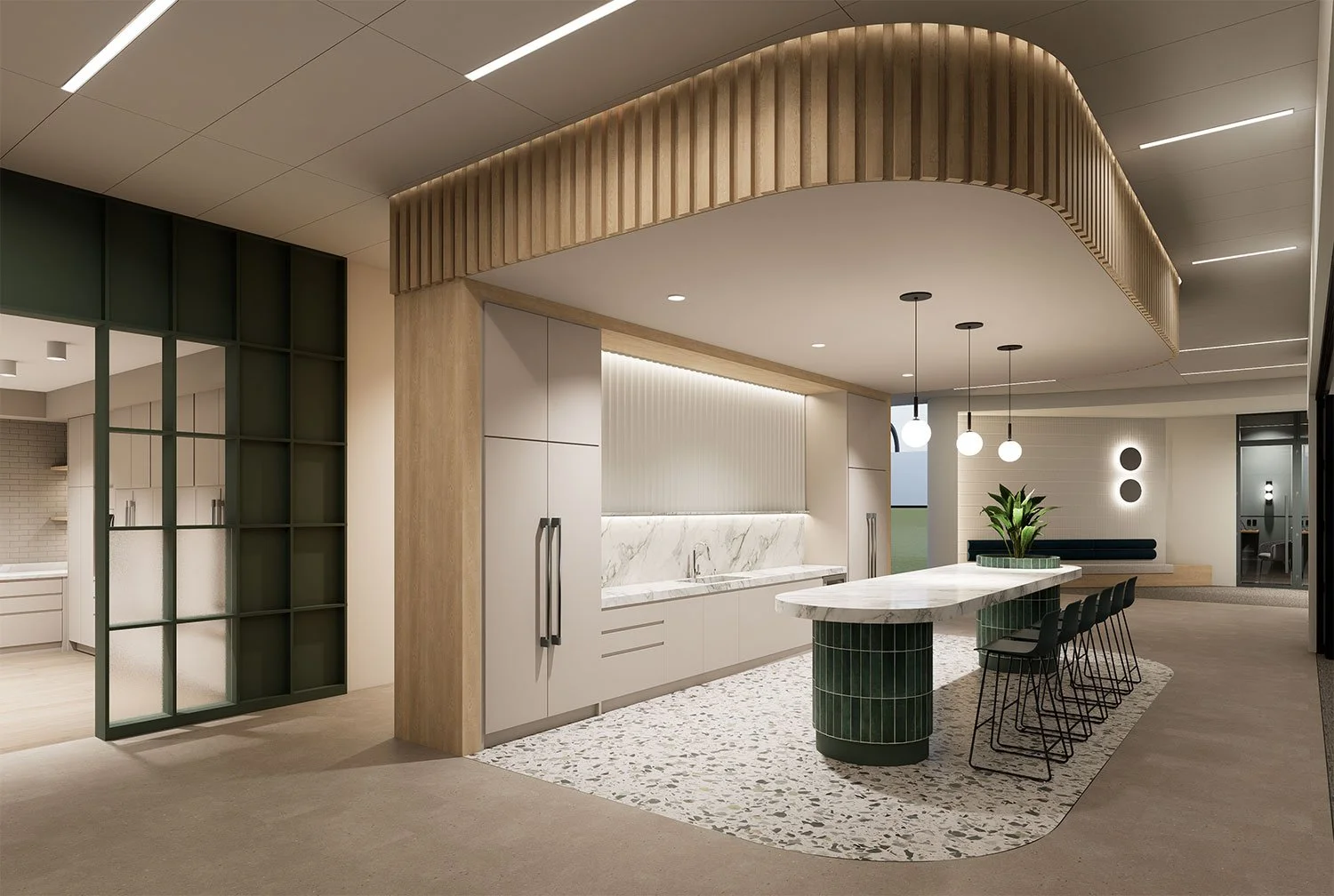
The Financial Necessity of Eco-Adaptive Design
Here is where we integrate the Maybeck "Eco-Adaptive" philosophy, which is the cornerstone of responsible 2026 design. It is not just "green." It is adaptive sustainability that creates immediate operational savings.
1. Regenerative Biophilia: It’s Not Just Plants
Generic biophilic design (putting a plant on a desk) is basic. Regenerative biophilia uses living systems to improve indoor air quality (IAQ) and cognitive function actively.
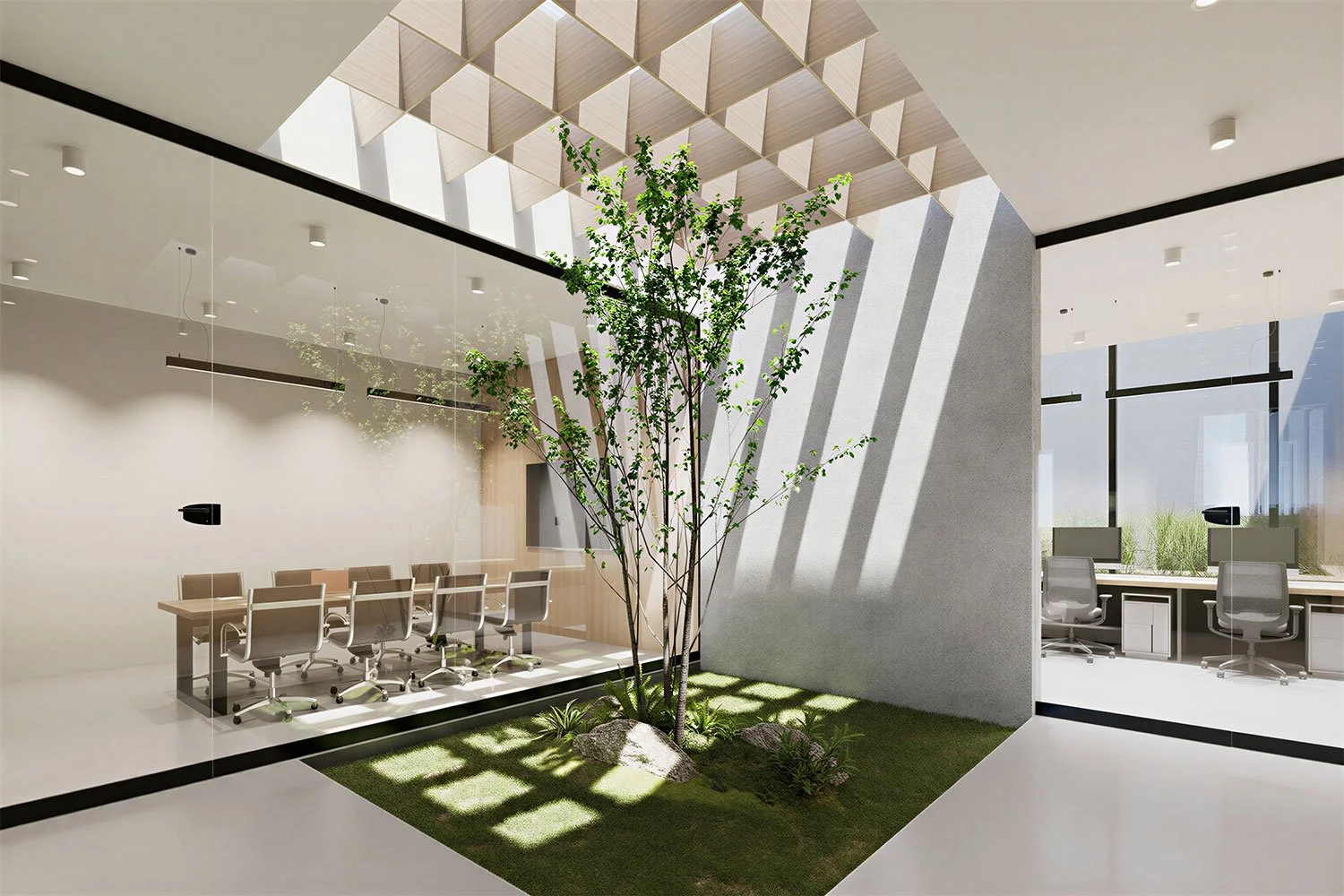
We integrate complex, multisensory living walls that act as natural bio-filters, reducing particulate matter and CO2 levels that cause the "afternoon slump." Fresh air and living systems are direct cognitive stimulants.
The Economic Metric: Studies consistently show a 6-15% productivity uplift in spaces with complex biophilic design. For an organization with 100 employees, this is millions in recovered capacity.
2. High-Efficiency Energy Systems and Carbon-Negative Materials
An Eco-Adaptive space is future-proofed against rising energy costs. We specify smart, AI-driven building management systems (BMS) that learn occupancy patterns, optimizing HVAC and lighting in real-time.
Furthermore, we source carbon-negative, regenerative materials—think bio-cement and advanced timber—that often carry significant tax credits and future-proof your asset against tightening carbon regulations. This isn't just ethical; it's a strategic hedge.
Strategic Cost Management: How We Fund Your Transformation
This is the question every founder asks: "This sounds advanced. Can I afford it?"
My answer is always: "Can you afford not to?" The cost of employee disengagement and turnover is vastly higher than the cost of a high-performance fit-out. But at Maybeck Design, we manage the cost by ruthlessly prioritizing what matters.
We utilize Spatial Intelligence Auditing (data on exactly how your old office was actually used, not how you think it was used) to right-size your new lease. Most companies pay for 20–30% more space than they need. We eliminate that waste and reinvest those savings into the cognitive-enhancing fit-out.
Your Action Plan for 2026:
Stop Aesthetic Guessing: Ban the word "looks" from your design vocabulary. Start using "functions," "supports," and "calculates."
Audit for Focus: How many minutes of deep work can your team achieve right now? Your design must protect focus.
Invest in Air and Light: If you are cutting costs, do not cut them on IAQ or lighting systems. These are the life support systems for your team’s cognitive energy.
Adopt Eco-Adaptive: Demand that your design team provides data on both the carbon and operational savings ROI.
An office that works for you is not a luxury. It is a fundamental strategic asset. In a world of intense competition, your physical space is your anchor—the final, unfair advantage that unites your people and accelerates your mission.
Stop designing pretty offices. Let’s start designing profit.

Frequently Asked Questions about Strategic Office Design
1. What is Psycho-Strategic Office Design? Psycho-strategic office design is a data-driven approach that combines environmental psychology with business objectives. Unlike traditional design, it uses spatial geometry, acoustic zoning, and bio-adaptive lighting to specifically lower cortisol levels and trigger "flow state" productivity. At Maybeck Design, we use this framework to ensure your physical workspace acts as a measurable asset for human capital.
2. How does an office layout impact employee ROI? The ROI of an office layout is measured through "recovered productive time." Studies show that reducing acoustic distractions and implementing sensory-inclusive zones can recover up to 86 minutes of deep-focus work per employee, per day. For a mid-sized company, this translates to hundreds of thousands of dollars in annual capacity that was previously lost to "open-plan fatigue."
3. What are the benefits of an Eco-Adaptive office fit-out? An Eco-Adaptive fit-out goes beyond basic "sustainability." It focuses on adaptive systems—like AI-driven HVAC and regenerative biophilia—that reduce operational energy costs by up to 30%. By using carbon-negative materials and flexible modular furniture, Maybeck Design ensures your office is future-proofed against rising energy taxes and evolving building regulations.
4. Can a small office space still utilize high-performance design? Absolutely. In fact, smaller square footage requires higher strategic precision. We utilize "Spatial Intelligence Auditing" to eliminate dead zones and replace them with multi-functional "Nesting Zones." High-performance design allows you to do more with less, often allowing companies to downsize their lease while increasing their team’s actual output.
5. Why is sensory-inclusive design important for 2026 businesses? With neurodiversity now recognized as a competitive advantage in the workforce, sensory-inclusive design ensures your top talent isn't being sidelined by their environment. By providing a choice between high-stimulation collaborative hubs and low-stimulation focus cocoons, you reduce burnout and increase retention, which is the most significant cost-saving a CBO can achieve.