
The Crown & Bloom: How a Members' Lounge Becomes a Development's Highest-Value Amenity
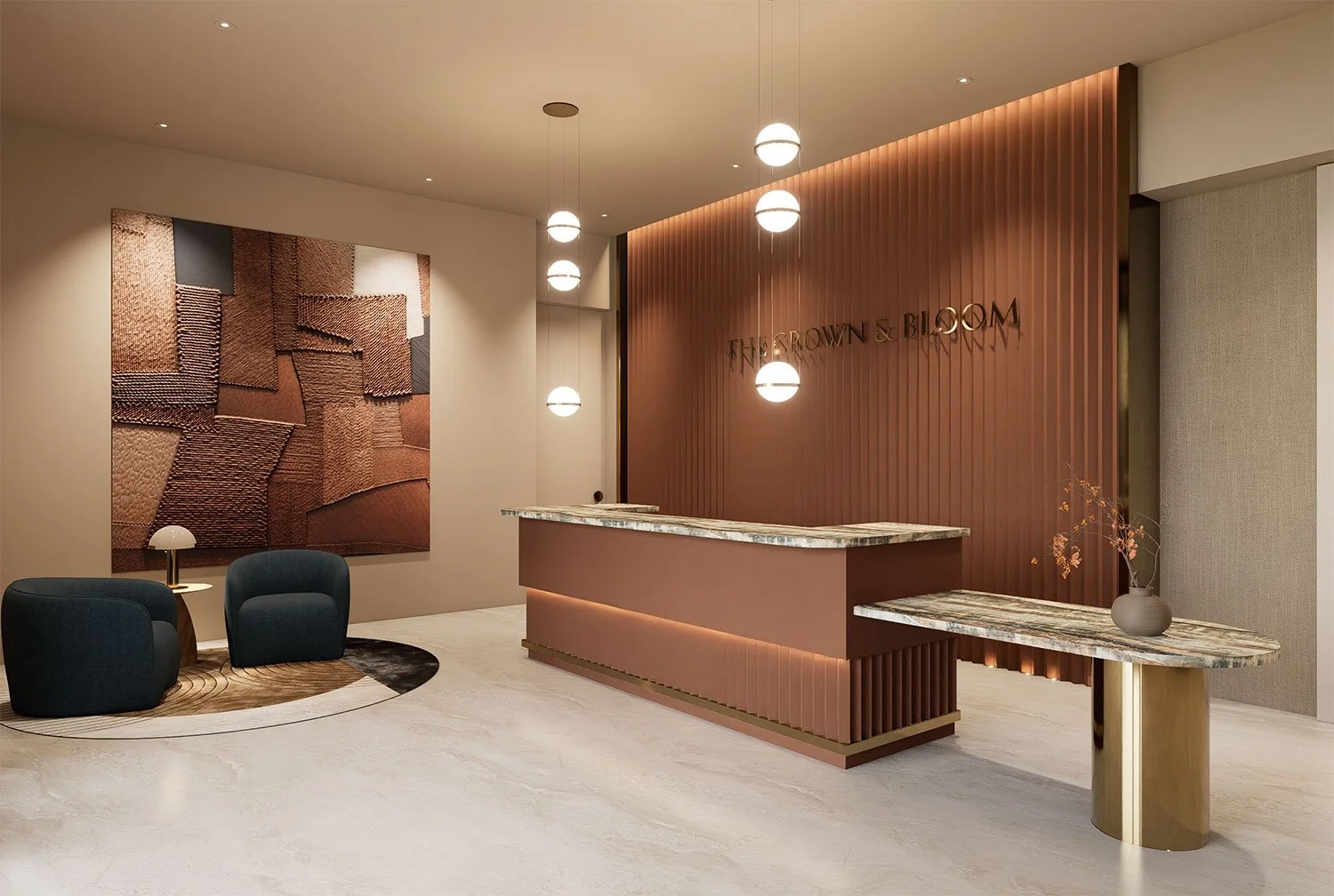
Most developers still budget amenity spaces the way they budget a hallway — square footage to fill, a line item to keep lean. The instinct is to treat the clubhouse or lounge as a required box to check on the site plan, something residents will use occasionally and forget about the rest of the time.
But the properties winning renewals and commanding premium rents right now aren't the ones with the most amenity square footage. They're the ones with a room residents actually build their evenings around.
The truth is, a members' lounge isn't a shared living room. It's the single space most capable of making an entire community feel like a brand — and when it's designed with intention, it becomes one of a development's highest-leverage assets for leasing, retention, and resident lifestyle.
That was the brief behind The Crown & Bloom, a members-only lounge Maybeck Design recently completed as the social heart of a residential community. Here's what the project reveals about designing amenity space as a strategic asset, not a cost center.
The Anchor Amenity: Why One Room Can Define an Entire Community
Every community has a handful of touchpoints that shape how residents describe living there — the lobby, the leasing tour, and increasingly, the shared lounge. Of those, the lounge does the most work. It's the space residents bring guests to, host in, work from, and photograph. Get it right, and it becomes shorthand for the entire property's quality level. Get it wrong, and the most expensive finishes in the building still can't compensate for a resident experience that feels like an afterthought.
The Crown & Bloom was designed around that principle from the start: inspired by the timeless elegance of private clubs and boutique hotels, it was built to deliver a sophisticated, upscale retreat for both social and professional gatherings — blending hospitality-driven design with the comfort of home, so the space reads as elevated without ever feeling unreachable to the residents it belongs to.
Inside the Design: Material Choices That Do Double Duty
Every material decision in the lounge was made to serve two jobs at once — everyday livability and a level of polish that photographs and performs like a hospitality space. The palette centers on warm natural stone, fluted walnut millwork, textured wall panels, sculptural lighting, and bespoke furnishings, layered together into what reads as understated luxury rather than a showroom.
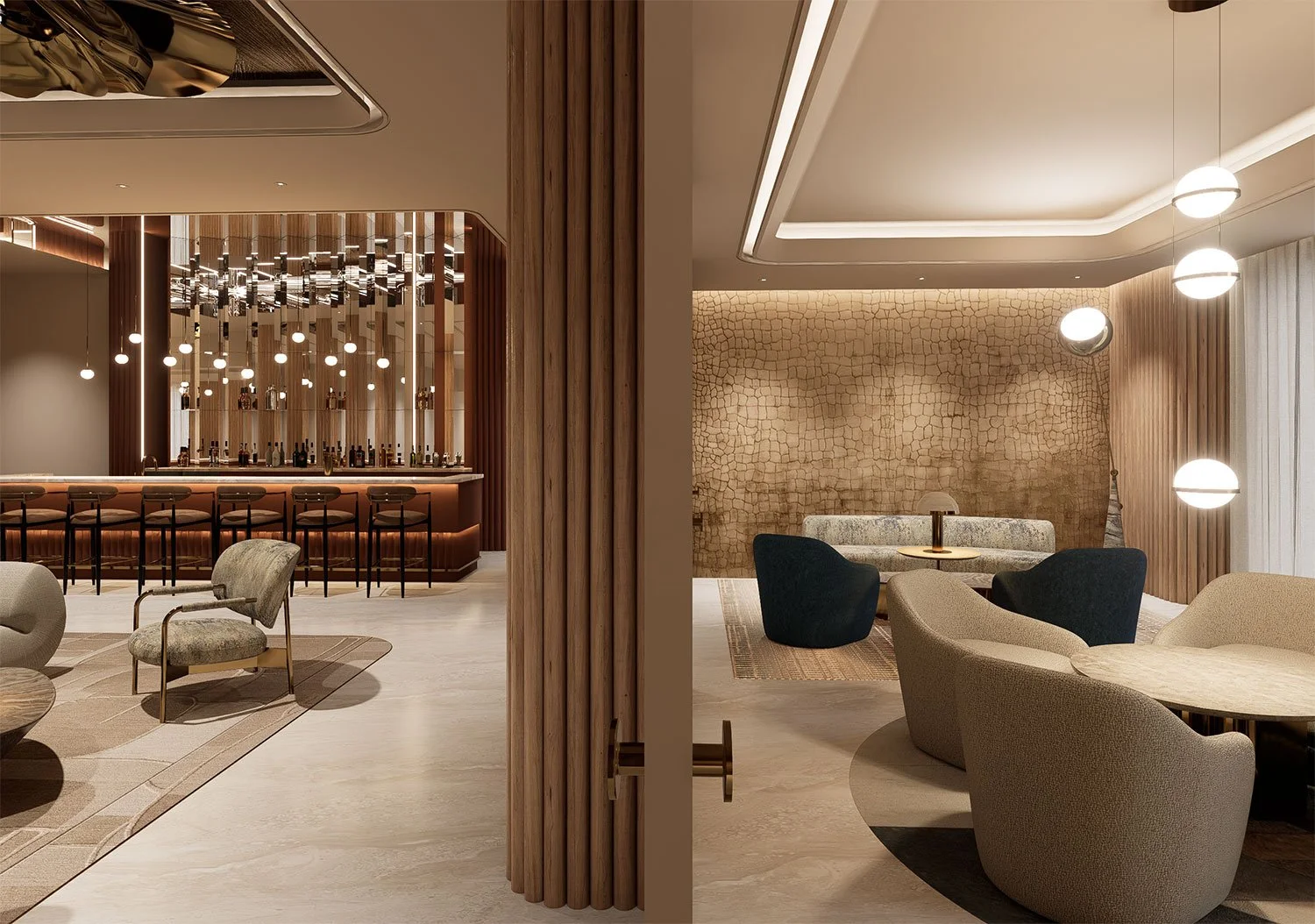
Three design decisions in particular carry the space:
Flexible Seating Choreography — Curated seating arrangements transition effortlessly from intimate conversations and remote work during the day to evening cocktails and community events at night, so the room never feels like it's built for only one occasion. This flexibility is what turns a single amenity into multiple daily use cases, maximizing the return on every square foot.
The Custom Cocktail Bar as Focal Point — A bespoke cocktail bar anchors the room the way a great bar anchors any hospitality venue — as a striking visual center that structures how residents naturally gather, mirroring the same "bar as anchor" principle that defines high-performing restaurant and nightlife interiors.
Layered Texture as Warmth — Dimensional wallcoverings, natural wood slat detailing, handcrafted stone surfaces, luxurious textiles, and integrated architectural lighting work together throughout the lounge, creating an immersive environment that feels contemporary and inviting rather than cold or overly formal — a common failure point in amenity spaces that lean too hard into "modern" at the expense of comfort.
The Signature Moment: Designing for Memory
The single most important lever in any amenity space is the one unmissable design moment that gives residents something to remember and something to show. In The Crown & Bloom, that moment happens overhead: a dramatic installation of sculptural Golden Magnolia ceiling elements, finished in a reflective metallic surface that captures and diffuses light throughout the room, introducing movement, depth, and artistry.
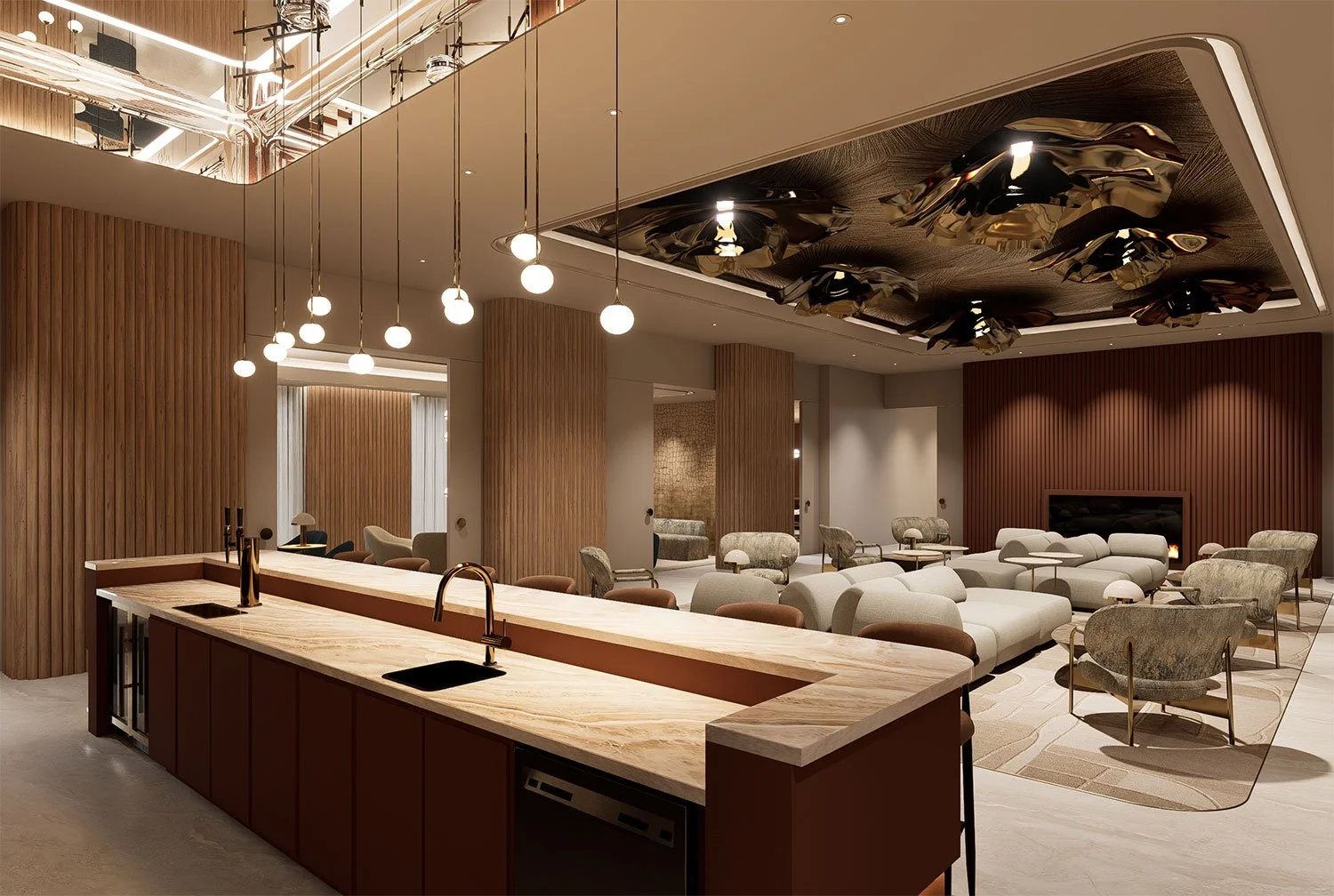
The choice of motif isn't decorative for its own sake. The magnolia is an enduring symbol of Southern hospitality, strength, and timeless elegance, giving the installation a narrative anchor as well as a visual one — the kind of specific, place-rooted storytelling that keeps a design from reading as generic, and gives residents a reason to talk about the room beyond "it's nice."
This is the same principle that separates a forgettable amenity from a differentiating one: a signature architectural moment does more marketing for a property, at zero incremental spend, than almost any paid campaign could.
The Strategic ROI of a Designed Amenity Space
For developers evaluating where amenity dollars go, the return on a project like The Crown & Bloom shows up in three concrete places:
Leasing Velocity and Premium Positioning — A signature amenity space gives leasing teams a genuine differentiator to sell against comparable properties, supporting both faster lease-up and stronger rent positioning in a competitive submarket.
Resident Retention Through Everyday Use — Because the lounge is designed for daytime work, casual gathering, and evening entertaining alike, it earns regular use rather than sitting empty between the occasional planned event — and residents who actually use their amenities renew at higher rates.
Organic, Ongoing Brand Marketing — A space built around one clear signature moment, like the Golden Magnolia installation, becomes a recurring subject of resident photos and social content, functioning as free, compounding marketing for the property long after the ribbon-cutting.
Conclusion: Amenity Space Is a Design Decision, Not a Line Item
The result at The Crown & Bloom is a distinctive neighborhood amenity that fosters community, elevates the resident lifestyle, and drives long-term value for the development — proof that a lounge designed with the same rigor as a boutique hotel or private club performs like one, both in how residents experience it and in what it returns to the property.
If your next community's amenity space is still being treated as square footage to fill rather than a room built to earn its keep, Maybeck Design partners with developers to design amenity spaces that function as both lifestyle asset and revenue driver. Let's talk about what your signature moment should be.
FAQ You Might Have
Q: What makes a members' lounge or resident amenity space actually drive ROI?
A: Flexibility and a signature design moment. Spaces that support multiple daily uses — work, casual gathering, evening entertaining — get used consistently rather than sitting empty, and one unmissable architectural feature gives the property ongoing, organic marketing value through resident-generated content.
Q: How does amenity design affect leasing and retention?
A: A well-designed amenity space gives leasing teams a genuine differentiator against comparable properties, supporting stronger rent positioning, while residents who regularly use their amenities are measurably more likely to renew.
Q: What was the design concept behind The Crown & Bloom's ceiling installation?
A: The sculptural Golden Magnolia ceiling elements use a reflective metallic finish to diffuse light and add movement throughout the lounge, drawing on the magnolia as a symbol of Southern hospitality, strength, and timeless elegance to give the space a narrative anchor beyond pure decoration.
Q: How is a hospitality-inspired amenity space different from a standard resident lounge?
A: It borrows directly from private club and boutique hotel design principles — a strong material palette, a clear focal point like a custom bar, and layered texture and lighting — rather than defaulting to generic multifamily common-area finishes.
Q: Should amenity space budgets prioritize square footage or design quality?
A: Design quality. A smaller, intentionally designed space with a genuine signature moment consistently outperforms a larger, undifferentiated one in resident usage, retention, and the property's ability to market itself.